
Smoke does not respect room boundaries. A small kitchen fire can leave residue inside closets, stain ceilings down the hall, contaminate an air-conditioning system, and embed a stubborn odor in furniture that never touched a flame. That is why Smoke Damage Insurance Claims require more than a quick inspection of the burned area. Strong claims account for the full path traveled by smoke, soot, heat, and firefighting water. The damage may look manageable at first. A restoration crew wipes a wall, places a deodorizing machine in the hallway, and says the smell should fade. Then the air conditioner turns on. The odor returns, pale surfaces begin to yellow, and black residue appears around vents that looked clean only days earlier.
Fire also changes materials through heat-driven chemical processes. One example is pyrolysis, a complex term for thermal decomposition that can occur when materials are exposed to high temperatures. Even when an object does not burst into flames, heat can alter its surface, weaken finishes, and contribute to residue that spreads throughout a property.For property owners in Hutto, the first days after a fire can become chaotic. Contractors want authorization. The insurance company wants a recorded account. Damaged belongings need to be moved, the building may require emergency protection, and your family or employees may need somewhere else to stay. Every decision feels urgent.
Slow down where you safely can. You must prevent additional damage, but you should not erase evidence needed to establish the extent of the loss. Cleaning every surface, throwing away smoky belongings, running the HVAC system, or authorizing broad demolition before documentation can make the claim harder to prove. A successful claim is not built around one dramatic photograph of a burned room. It is built around smaller details: residue inside cabinets, odor in fabric, discoloration above doorways, soot around electrical outlets, contaminated insulation, damaged food, affected electronics, and increased living expenses.
This is where many claims begin to fall short. An insurance estimate may focus on what can be seen during a brief walkthrough, while the actual damage extends into concealed spaces and porous materials. The initial payment can therefore look substantial while still leaving major work unfunded. The goal is not to inflate the loss. It is to describe it accurately. That requires a disciplined process. You need photographs, inventories, repair estimates, inspection reports, receipts, correspondence, and a clear record of which materials can be cleaned and which must be replaced. You also need to understand coverage, depreciation, and what to do when the insurer’s scope does not match the property’s condition. The article When Insurance Timing Quietly Costs You Thousands captures a problem that appears repeatedly in smoke losses: deadlines, delayed inspections, premature cleanup, and late supplemental documentation can affect how smoothly a claim moves forward. Acting promptly matters, but acting blindly can be just as costly.
What Counts as Smoke Damage?
Smoke damage includes more than a visible gray film on a wall. It can involve soot, ash, oily residue, acidic particles, odors, heat-related discoloration, and contamination carried through the property by moving air.
Affected materials may include:
- Drywall, paint, trim, and ceilings
- Cabinets, countertops, and flooring
- Attic and wall insulation
- Heating and cooling equipment
- Ductwork, vents, filters, and returns
- Furniture, mattresses, rugs, and curtains
- Clothing, linens, books, and documents
- Computers, televisions, and appliances
- Food, cosmetics, medication, and hygiene products
- Inventory, equipment, and business records
Smoke can enter small gaps around doors, electrical plates, plumbing penetrations, recessed lights, and cabinets. It may move upward through wall cavities or travel between rooms through return-air pathways. Consequently, a room that appears untouched may still require professional evaluation. Odor is also part of the damage. It is not merely an inconvenience to be masked with fragrance. A persistent smoky smell can indicate that residue remains on a surface, inside a porous material, or within the ventilation system.
Does Homeowners Insurance Cover Smoke Damage?
Many homeowners policies cover sudden and accidental fire and smoke damage. Coverage may apply even when flames originated outside the home or smoke traveled from another area of the building.
Still, no two policies are identical. Coverage can depend on the cause of the loss, policy form, endorsements, exclusions, deductibles, property use, vacancy conditions, and whether the policyholder complied with post-loss duties. A residential policy may also treat the structure, detached buildings, personal property, and temporary living expenses as separate categories.
| Coverage | What It May Address |
| Dwelling | Damage to the house and attached components |
| Other structures | Detached garages, sheds, fences, and similar property |
| Personal property | Furniture, clothing, electronics, and household items |
| Loss of use | Temporary housing and increased living expenses |
| Debris removal | Disposal of covered damaged materials |
| Ordinance or law | Certain additional costs required by current codes |
Coverage should not be confused with valuation. An insurer may agree that the smoke loss is covered while disputing how many rooms require treatment, whether cabinets can be cleaned, or whether electronics should be replaced. A coverage dispute asks whether the policy responds to the loss. A valuation dispute asks how much covered damage occurred and what it will cost to address it.
Your First Steps After a Smoke Loss
Safety comes first. Do not enter a property until emergency officials or qualified professionals determine that it is safe. Once immediate dangers are controlled, begin protecting both the property and your claim.
Notify the Insurance Company
Report the loss promptly and obtain a claim number. Ask for the assigned adjuster’s contact information and request written instructions regarding emergency work, damaged contents, temporary housing, and inspections. Keep your initial description factual. Explain what happened, when it happened, where it began, and which areas appear affected. Avoid guessing about causes or declaring that certain rooms are undamaged before a complete inspection.
Photograph Before Cleaning
Take wide-angle photographs of every room, including areas that appear relatively clean. Then take close-up photographs of:
- Walls and ceilings
- Door frames and trim
- Vent covers and return grilles
- Cabinet interiors
- Shelves and drawers
- Electronics and appliances
- Upholstered furniture
- Clothing and linens
- Food and household products
- Attic access points
Use video as well. Walk slowly through the building and narrate what you see and smell. Video cannot capture odor, but your spoken observations create a dated record of its location and intensity.
Prevent Additional Damage
Reasonable emergency steps may include boarding openings, covering roof damage, extracting standing water, securing the property, and placing equipment to control humidity. Document these actions before and after they are performed. Save invoices, work authorizations, photographs, and moisture readings. Emergency mitigation is not permanent restoration. You can authorize work needed to prevent further damage while reserving decisions about demolition, replacement, and reconstruction until the loss has been evaluated.
What Not to Do Before the Inspection
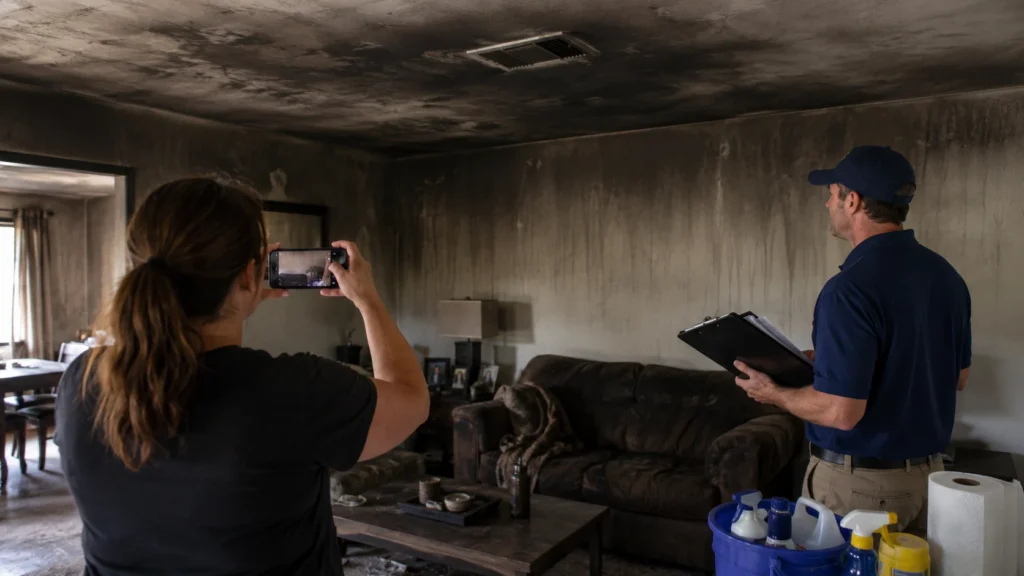
The impulse to clean immediately is understandable. Smoke feels invasive, and most owners want the property to look normal again as quickly as possible. Yet premature cleaning can destroy evidence. Avoid repainting, sealing surfaces, washing walls, laundering all textiles, discarding contents, or applying strong deodorizing products before comprehensive documentation. Also avoid operating contaminated HVAC equipment unless a qualified professional says it is appropriate.
Do not sign an open-ended work authorization without understanding:
- What work is being approved
- How charges will be calculated
- Whether storage fees will apply
- Who can authorize disposal
- Whether the contractor may communicate directly with the insurer
- Whether you remain responsible for unpaid amounts
- How the agreement can be cancelled
Read every document. Ask for a copy before work begins.
How to Document Smoke Damage Insurance Claims
Good documentation changes outcomes. It helps contractors prepare accurate estimates, allows the insurer to evaluate the loss, and gives you a record to rely on when memories become less precise.
Build a Room-by-Room Damage Record
Create a separate entry for each room. Note visible soot, odor intensity, affected surfaces, damaged fixtures, contents requiring inspection, areas already cleaned, inaccessible spaces, and recommended testing. Do not group the entire property under a vague description such as “the whole house smells smoky.” Be specific. State that odor is strongest inside the upstairs linen closet, residue is visible around the return vent, and the painted hallway ceiling has developed yellow-gray discoloration.
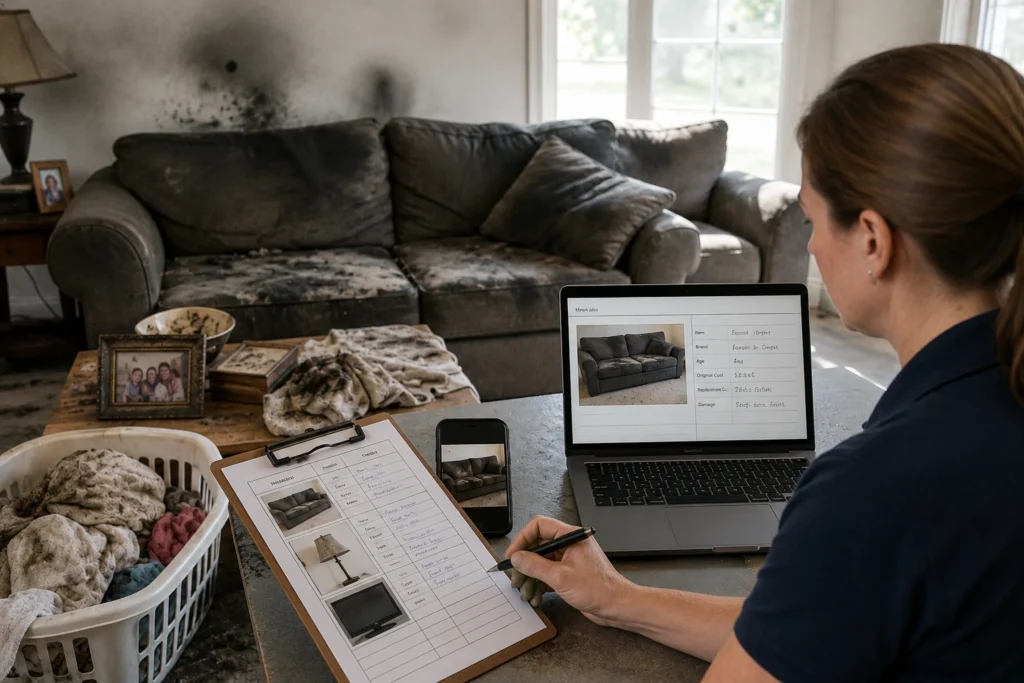
Create a Personal Property Inventory
A useful contents inventory should include:
| Information | Example |
| Item | Three-seat fabric sofa |
| Brand | Manufacturer name, when known |
| Age | Purchased approximately four years ago |
| Original cost | Amount paid |
| Replacement cost | Current cost of a comparable item |
| Damage | Heavy odor and visible residue |
| Location | Living room |
| Evidence | Receipt, photograph, or online listing |
| Proposed action | Clean, evaluate, or replace |
Work one room at a time. Use pre-loss photographs, online purchase histories, bank statements, emails, warranties, and family videos to identify belongings. Do not undervalue ordinary items. Towels, utensils, books, shoes, bedding, toiletries, pantry goods, and cleaning supplies can represent a meaningful portion of the contents claim when added together.
Maintain a Claim Journal
Record every call, email, inspection, request, and promise. Include the date, time, person involved, and next step. After an important telephone conversation, send a short email summarizing your understanding. For example:
“Thank you for speaking with me today. My understanding is that the HVAC inspection will occur before the system is operated and that damaged contents should remain available until they have been documented.” That message creates clarity without turning every interaction into a confrontation.
Cleaning Versus Replacement
This is one of the central disputes in Smoke Damage Insurance Claims. Insurance estimates often favor cleaning because it costs less than replacement. Cleaning may be appropriate for some materials. The issue is whether the proposed process can restore the item to its pre-loss condition without leaving odor, residue, staining, functional damage, or a shortened service life.
Cleaning May Be Reasonable When:
- The material is nonporous
- Residue is light and accessible
- The finish will not be damaged
- Manufacturer-approved methods are available
- A test cleaning produces acceptable results
- The item can be evaluated afterward
Replacement May Be More Appropriate When:
- Residue has penetrated porous material
- Odor remains after proper cleaning
- The surface is permanently discolored
- Heat has distorted or weakened the item
- Cleaning voids a warranty
- The material cannot be accessed fully
- Restoration costs approach replacement costs
Ask the contractor or vendor to explain the proposed method. “Clean as needed” is not a meaningful scope. A proper estimate should identify the surface, technique, number of applications, access requirements, and post-cleaning verification. Test cleaning can be useful. Select a representative area, photograph it before and after, and evaluate the result under normal lighting. If odor or staining remains, document it.
Smoke Odor Is Not a Cosmetic Detail
Odor disputes can become frustrating because smell is difficult to photograph and personal sensitivity varies. Still, persistent odor matters. The goal should be to remove the source, not simply cover it. Fragrance, fogging, ozone, hydroxyl treatment, activated carbon, sealing, and air filtration may be parts of a restoration plan, but no single procedure fits every property.
A logical odor-remediation sequence often includes:
- Removing debris and unsalvageable materials
- Cleaning accessible contaminated surfaces
- Evaluating concealed spaces
- Inspecting the HVAC system
- Treating remaining odor appropriately
- Ventilating the property
- Reassessing after equipment is removed
Be cautious when a strong treatment makes the odor impossible to assess temporarily. Reinspect after the treatment scent has dissipated and the building has returned to ordinary conditions.
HVAC Systems and Ductwork
A heating and cooling system can move residue from one part of a building to another. Return vents may draw contaminated air into filters, blower components, coils, plenums, and ducts. Supply vents may then distribute particles into rooms that were initially less affected.
Do not assume that replacing the filter solves the problem.
An HVAC evaluation should consider:
- Whether the system was operating during or after the fire
- The location of return vents
- Visible residue around registers
- The condition of filters
- Duct accessibility and construction
- Internal insulation
- Blower and coil contamination
- Odor when the system operates
- Manufacturer cleaning recommendations
- Whether cleaning can be verified
Flexible ducts and internally lined ducts may present different restoration challenges from bare metal ductwork. The appropriate response may range from component cleaning to partial or complete replacement. For Hutto property owners facing hot weather, the pressure to restart air conditioning can be intense. Document the system first. Running it without evaluation may spread residue and complicate the effort to identify where contamination originated.
Additional Living Expenses
A home does not need to be destroyed to become temporarily unfit for normal living. Smoke odor, lack of utilities, exposed wiring, active demolition, contaminated HVAC equipment, or an unusable kitchen may force residents to relocate. Loss-of-use coverage may help pay the reasonable increase in living costs caused by a covered loss, subject to policy terms and limits.
Potential expenses include:
- Hotel or rental housing
- Increased meal costs
- Laundry
- Storage
- Pet boarding
- Furniture rental
- Additional transportation
- Utility setup costs
- Parking
- Moving expenses
The key word is “increased.” If you normally spend $600 per month on groceries but spend $1,000 because the kitchen is unusable, the potential claim may concern the $400 increase rather than the entire $1,000. Keep receipts. Create a spreadsheet. Note why each expense was necessary. Ask the adjuster how long temporary housing is approved and what documentation is required for an extension. Do not wait until the final approved day to explain that repairs remain months from completion.
Replacement Cost, Actual Cash Value, and Depreciation
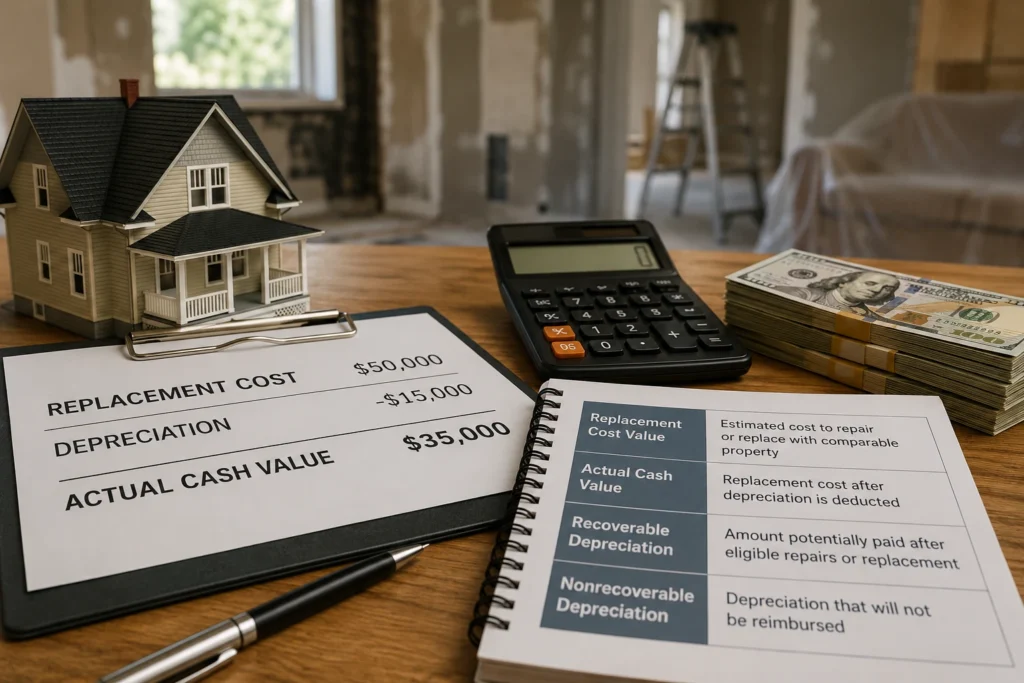
Insurance payments may be calculated using replacement cost value or actual cash value. Replacement cost generally reflects the current cost to repair or replace covered property with comparable property. Actual cash value usually reflects replacement cost minus depreciation.
| Term | Practical Meaning |
| Replacement cost value | Estimated cost to repair or replace with comparable property |
| Actual cash value | Replacement cost after depreciation is deducted |
| Recoverable depreciation | Amount potentially paid after eligible repairs or replacement |
| Nonrecoverable depreciation | Depreciation that will not be reimbursed |
| Deductible | Amount applied under the policy |
Suppose replacement of smoke-damaged flooring is estimated at $18,000. The insurer applies $4,000 in depreciation and a $2,500 deductible. The initial payment might be based on $11,500, while some or all of the $4,000 may be recoverable after qualifying work is completed.
Review the depreciation carefully. Check the assumed age, condition, useful life, quantity, and whether depreciation was applied to labor as well as materials. Also review deadlines. Some policies require repairs or replacement within a specific period before recoverable depreciation can be claimed.
Why Smoke Damage Claims Are Underpaid
Underpayment does not always result from a dramatic denial. More often, it develops through many smaller omissions.
Common examples include:
- Cleaning one room while excluding adjacent areas
- Wiping vents without evaluating the HVAC system
- Cleaning cabinets without addressing unfinished interiors
- Omitting insulation
- Using inaccurate room measurements
- Excluding contents manipulation
- Limiting textile cleaning
- Ignoring post-construction cleaning
- Applying excessive depreciation
- Ending temporary housing too early
- Pricing specialty work as ordinary labor
- Failing to include access and reinstallation costs
- Treating persistent odor as resolved without verification
Compare estimates by scope, not only by total. One contractor may include demolition, disposal, cleaning, sealing, replacement, painting, contents movement, equipment setup, and final cleaning. Another may use one broad line item that leaves half of those tasks undefined.
Denied Smoke Damage and Written Explanations
When the insurer denies all or part of the loss, ask for the decision in writing. The explanation should identify the policy language being applied and the factual basis for the decision.
Review whether the denial concerns:
- The cause of the fire
- An exclusion
- Maintenance or wear
- Vacancy
- Intentional conduct
- Late notice
- Failure to protect the property
- Lack of documentation
- Disagreement over cleaning versus replacement
A denial is not always the end of the discussion. New evidence, corrected facts, contractor findings, or a clearer explanation of the damage may support reconsideration. Do not ignore deadlines while requesting review. Policies and applicable laws may impose time limits for submitting documentation, completing replacement, demanding appraisal, or pursuing other remedies.
When a Public Adjuster May Help
The insurance company’s adjuster works for the insurer. A public adjuster is engaged by the policyholder, subject to licensing rules and the terms of the service agreement.
A public adjuster may assist with:
- Reviewing the policy
- Inspecting the property
- Organizing damage documentation
- Preparing repair estimates
- Developing contents inventories
- Tracking additional living expenses
- Communicating with the insurer
- Presenting supplemental damage
- Reviewing settlement calculations
Not every smoke claim requires professional representation. A small, straightforward loss may be resolved through clear documentation and a competent contractor.
However, assistance may be worth considering when the loss affects multiple rooms, the property is uninhabitable, business operations are interrupted, contents are extensive, specialists disagree, or the insurer’s estimate remains materially below documented repair costs. Review fees, services, cancellation rights, and responsibilities before signing any agreement.
A Practical Smoke-Loss Example
Imagine a stovetop fire that is extinguished before flames spread beyond the kitchen. At first, the structural damage appears limited to the range hood, two cabinets, the backsplash, and part of the ceiling. The initial estimate covers cabinet cleaning, repainting the kitchen, replacing the range hood, and deodorizing the room.
However, a detailed inspection finds:
- Protein residue on adjoining dining-room walls
- Odor inside the pantry
- Soot around an upstairs return vent
- Contamination in the blower compartment
- Smoke odor in upholstered furniture
- Damaged food and open household products
- Discoloration on nearby wood finishes
- Temporary housing expenses while the kitchen and HVAC system are unusable
The difference is not exaggeration. It is scope. Once these additional areas are photographed, tested, inventoried, and priced, the claim can be evaluated based on the complete loss rather than the most obvious burned surfaces. That is the central lesson of Smoke Damage Insurance Claims: the point of origin is only the beginning of the inspection.
Final Smoke Damage Claim Checklist
Before Cleanup
- Photograph and record video of every room.
- Document odors in a written journal.
- Preserve damaged materials when safe.
- Notify the insurance company.
- Obtain the claim number and adjuster information.
- Complete only necessary emergency work.
- Avoid running the HVAC system without evaluation.
- Do not discard property without documentation.
During the Claim
- Attend inspections when possible.
- Build a room-by-room damage list.
- Prepare a detailed contents inventory.
- Save every receipt.
- Request written estimates and reports.
- Compare the insurer’s scope with contractor findings.
- Track applicable deadlines.
- Confirm important conversations by email.
- Submit additional damage promptly.
Before Accepting the Settlement
- Confirm that every affected room is included.
- Review cleaning versus replacement decisions.
- Check measurements and quantities.
- Review HVAC and ductwork findings.
- Verify personal property values.
- Examine depreciation.
- Confirm temporary housing calculations.
- Understand recoverable depreciation requirements.
- Read any release before signing.
Final Thoughts
Smoke losses are rarely as simple as they appear on the first day. Residue spreads. Odors settle into porous materials. Mechanical systems move particles. Temporary housing costs grow, and estimates change as hidden areas are opened. The solution is not panic. It is process. Document before cleaning. Inspect beyond the burned room. Require specific explanations for cleaning and replacement decisions. Track expenses. Review every estimate line by line. Preserve written records and address missing damage while evidence is still available.
Most importantly, remember that the objective is restoration, not a surface-level appearance of cleanliness. A property can look better while still holding odor, residue, mechanical contamination, or damaged contents. Handled carefully, Smoke Damage Insurance Claims can account for structural repairs, personal property, HVAC evaluation, odor remediation, temporary living expenses, and other covered consequences of a fire. Handled too quickly, they may leave serious damage undocumented and expensive work unpaid. Take the claim one room, one item, and one document at a time. That approach is not flashy, but it is effective. When your home or business is on the line, accuracy matters.
FAQs
Most homeowners policies cover sudden and accidental smoke damage, although coverage depends on the cause, exclusions, limits, and policy conditions.
Yes. Coverage may apply when smoke enters from a nearby fire, provided the cause is covered under the policy.
Avoid major cleaning until you photograph and document the damage. Premature cleanup can remove evidence needed to support the claim.
Replacement may be appropriate when odor, residue, staining, or heat damage cannot be removed without reducing the item’s condition or useful life.
A covered claim may include reasonable odor-remediation costs when the odor results from insured smoke damage and requires professional treatment.
Coverage may include HVAC inspection, cleaning, or replacement when smoke entered the system and the work is necessary to restore the property.
Provide photographs, videos, repair estimates, personal property inventories, inspection reports, receipts, and written communication with the insurer.
Loss-of-use coverage may reimburse reasonable increased living expenses when smoke damage makes the home unsafe or unsuitable for normal use.
Compare the estimate with contractor findings, identify missing work, submit supporting evidence, and request a supplemental review or reinspection.
A public adjuster may help when the damage is extensive, the claim is underpaid, documentation is complicated, or cleaning-versus-replacement disputes remain unresolved.