
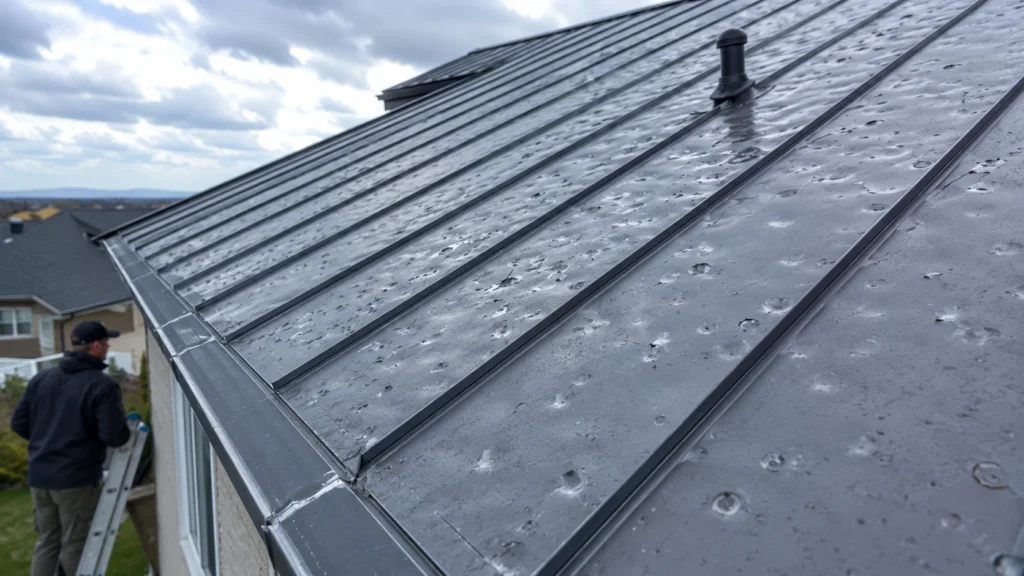
When a hailstorm passes, metal-roof owners often ask one urgent question: will insurance pay hail damage metal roof repair or replacement costs? In many cases, insurance may cover the loss, but payment is never automatic. Coverage depends on the policy wording, the cause and extent of the damage, the roof’s prior condition, the deductible, and whether the insurer classifies the damage as functional or cosmetic. Metal roofs are strong, but they are not invincible. Large hail pushed by high winds can dent panels, chip coatings, distort seams, loosen fasteners, damage flashing, and create pathways for water. Some problems can be seen from the ground. Others remain hidden until the next storm or until a detailed inspection reveals them.
For property owners in Hutto, the financial impact can be substantial. A standing-seam residential roof is a major investment, while the metal roof on a warehouse, retail building, church, or apartment property may cover thousands of square feet. Even a modest disagreement over repair scope can change a claim by tens of thousands of dollars. zThe key is to replace assumptions with evidence. A few dents do not always justify full replacement. At the same time, the absence of an active leak does not prove that the system escaped functional damage. A complete inspection should evaluate panels, seams, fasteners, coatings, penetrations, drainage components, rooftop equipment, and interior areas.
Property owners should also understand What Happens If You Delay a Roof Claim? Evidence can fade, temporary openings may worsen, later storms may complicate the reported date of loss, and policy deadlines may pass. Acting quickly does not mean signing the first contract offered. It means documenting conditions, protecting the property, reviewing the policy, and arranging a qualified inspection while the evidence remains clear.
How Hail Damages a Metal Roof
Hail damage depends on more than hailstone size. Wind speed, impact angle, storm duration, panel thickness, roof slope, substrate, metal type, coating condition, and installation method all influence the result. Two homes on the same street can suffer different levels of damage because their roof systems respond differently to impact. A strike near the center of a panel may leave a shallow dent. The same strike near a seam, rib, clip, fastener, vent, skylight, or ridge cap can affect attachment or water resistance. Location matters just as much as appearance.
Common forms of hail damage include:
- Dents and widespread dimpling
- Scratched, chipped, or fractured coatings
- Bent ribs and distorted panel profiles
- Open or weakened seams
- Loose or displaced fasteners
- Cracked washers and sealants
- Damaged ridge caps and flashing
- Punctures in thinner metal
- Dented gutters, vents, and downspouts
- Water intrusion around penetrations
- Moisture beneath damaged components
Not every dent has the same significance. A shallow mark in the flat field of a panel may be cosmetic. A similar impact at a locked seam may interfere with movement, drainage, or weather resistance. That is why a quick driveway inspection rarely provides enough information for a confident claim decision. The roof assembly beneath the metal also matters. Hail may deform a panel without creating an immediate hole, yet the impact can affect underlayment, insulation, decking, clips, or concealed fasteners. A professional evaluation should consider the entire system, not only the visible surface.
Will Insurance Pay Hail Damage Metal Roof Claims?
Most homeowners and commercial property policies may cover sudden hail damage when wind and hail are listed as covered causes of loss. However, the answer to will insurance pay hail damage metal roof costs depends on the individual contract and the facts of the storm.
Insurers typically consider:
- Whether hail is covered
- Whether the damage occurred during the reported event
- Whether the damage is new or pre-existing
- Whether roof performance is affected
- Whether a cosmetic exclusion applies
- Whether wear, corrosion, or faulty installation contributed
- Whether repair costs exceed the deductible
- Whether the roof is insured at replacement cost or actual cash value
- Whether the policy contains roof-age limitations
- Whether the policyholder met notice and documentation duties
Start with the policy, not with the dents. The declarations page, coverage forms, endorsements, exclusions, deductibles, valuation provisions, and duties-after-loss section work together. A verbal explanation from an adjuster, agent, or contractor cannot replace the written contract. Metal roofing also relies on protective finishes. When hail chips or separates a coating, the issue may extend beyond appearance because exposed metal can become vulnerable to corrosion. The concept of cohesion helps explain how materials hold together internally, which can be relevant when evaluating whether a coating has fractured or lost integrity after impact.
Functional Damage Versus Cosmetic Damage
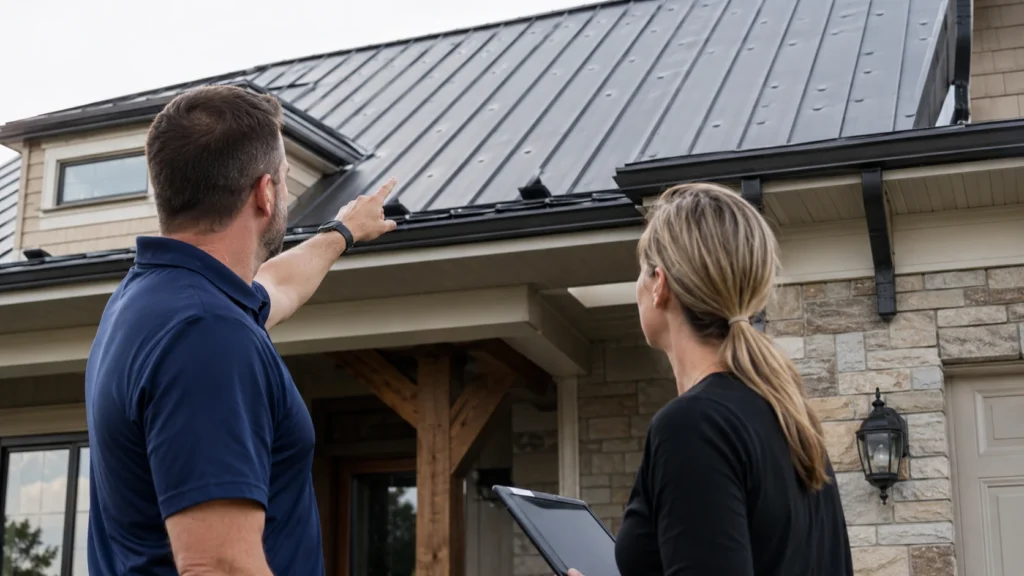
This distinction often determines the outcome of a metal-roof claim. Functional damage affects the roof’s ability to perform. It may impair water shedding, attachment, structural stability, drainage, expansion and contraction, corrosion resistance, or expected service life.
Examples include:
- Punctured or split panels
- Open mechanical seams
- Deformed panel locks
- Displaced clips or fasteners
- Damaged washers
- Cracked sealant at penetrations
- Coating loss that exposes bare metal
- Distorted flashing
- Active water intrusion
- Damage that prevents normal panel movement
Cosmetic damage changes appearance without immediately affecting performance. Shallow dents in otherwise intact panels are a common example.
The problem is that damage may look cosmetic from a distance while hiding functional effects. A dent may contain a coating fracture. A seam may appear closed but be distorted enough to restrict movement. A fastener may remain in place even though the impact damaged its washer. A roof may stay dry during light rain yet leak during wind-driven weather.
A proper inspection should answer specific questions:
- Where did the major impacts occur?
- Were seams, locks, ribs, fasteners, or penetrations affected?
- Did the finish crack, separate, or expose metal?
- Has the roof lost weather resistance?
- Can damaged panels be removed without harming surrounding components?
- Will the repair comply with manufacturer requirements?
- Is the damage consistent with the reported storm?
“Cosmetic only” should be a supported conclusion, not a label applied before the roof has been fully examined.
How Cosmetic Damage Exclusions Affect Coverage
Some policies contain endorsements that exclude or limit coverage for cosmetic hail damage to roof coverings. These provisions are especially important for metal roofs because dents can remain visible even when the insurer believes the panels still perform. A cosmetic exclusion does not always eliminate the entire claim. It may apply only to appearance-related damage while leaving coverage for punctures, failed seams, damaged flashing, coating loss, water intrusion, or other functional problems.
Property owners should review:
- The declarations page
- Main coverage form
- Wind and hail endorsements
- Cosmetic-damage endorsements
- Roof-surfacing schedules
- Actual-cash-value endorsements
- Deductible provisions
- Exclusions
- Duties after loss
- Loss-settlement terms
Do not rely only on the summary page. The controlling limitation may appear in an endorsement near the back of the policy.
What Adjusters Look for During an Inspection
An insurance adjuster may examine much more than the roof panels. The inspection can include siding, windows, screens, fences, gutters, vents, air-conditioning equipment, skylights, and other soft metals around the property. Why? Hail usually leaves a pattern. Collateral damage can help show direction, intensity, and approximate hail size. Fresh dents on gutters or rooftop equipment may support the reported event, while rusted marks or unrelated mechanical damage may point to an older cause.
| Inspection Area | What May Be Evaluated |
| Panel fields | Dents, punctures, scratches, coating fractures |
| Seams and ribs | Distortion, separation, failed locks |
| Fasteners | Movement, impact marks, damaged washers |
| Flashing | Bends, openings, displaced sections |
| Penetrations | Cracked sealant, damaged boots, water paths |
| Ridge and edge metal | Deformation, attachment, wind interaction |
| Gutters and downspouts | Hail dents, displacement, drainage problems |
| Rooftop equipment | Impact marks on vents, HVAC units, covers |
| Interior | Ceiling stains, moisture, damaged insulation |
| Attic or roof cavity | Water tracks, damp decking, concealed entry |
The adjuster may also distinguish storm damage from corrosion, foot traffic, installation marks, dropped tools, manufacturing irregularities, thermal movement, and older repairs. Those distinctions should be based on visible characteristics and supporting evidence.
Why Metal-Roof Hail Claims Become Disputed
When owners ask will insurance pay hail damage metal roof replacement costs, they are often surprised by the number of separate disagreements that can arise.
The insurer and property owner may dispute:
- Whether damage is functional
- Whether marks came from the reported storm
- Whether corrosion existed before the loss
- Whether individual panels can be repaired
- Whether matching panels are available
- Whether surrounding panels must be removed
- Whether coating damage reduces service life
- Whether labor rates are reasonable
- Whether lifts or scaffolding are necessary
- Whether interior moisture is related
- Whether code work is covered
- Whether payment should be replacement cost or depreciated value
The best response is detailed evidence. Statements such as “the entire roof is ruined” or “the dents mean nothing” are conclusions. Neither carries much weight without photographs, measurements, manufacturer guidance, repair methodology, policy language, and a realistic estimate.
Does Roof Age Affect Coverage?
An older metal roof is not automatically excluded from hail coverage. However, age can affect payment and make causation more complicated. Insurance generally responds to direct physical loss caused by a covered event. It does not normally pay for ordinary aging, corrosion, neglected maintenance, or gradual deterioration. The insurer may therefore try to separate new impact damage from long-term conditions.
Helpful records include:
- Previous inspection reports
- Installation invoices
- Manufacturer information
- Before-storm photographs
- Repair records
- Coating-maintenance records
- Warranty documents
- Leak history
- Tenant or maintenance logs
A well-maintained older roof may present a clearer claim than a newer roof with unresolved leaks and widespread corrosion. Condition matters alongside age.
Replacement Cost Versus Actual Cash Value
The settlement method can greatly affect the first payment.
| Valuation Method | General Calculation | Likely Effect |
| Replacement cost value | Cost to repair or replace with comparable materials | May allow recovery without permanent depreciation |
| Actual cash value | Replacement cost minus depreciation | Produces a lower initial or final payment |
| Recoverable depreciation | Amount released after qualifying work is completed | Usually requires invoices and proof of repairs |
| Nonrecoverable depreciation | Permanent reduction | Lowers the total settlement |
Suppose covered replacement work costs $60,000. If the insurer applies $15,000 in depreciation and a $5,000 deductible, the initial actual-cash-value payment may be about $40,000, subject to other adjustments. If depreciation is recoverable, the owner may request the withheld amount after completing covered work and submitting proof. Deadlines matter. Some policies require repairs within a stated period before recoverable depreciation becomes payable. Read that provision early.
Can the Insurer Pay for Only Part of the Roof?
Yes. Insurance normally pays for covered damage, not automatically for every component on the building. If only a few panels have functional damage and compatible replacements are available, the insurer may estimate isolated repairs. The owner or contractor may argue that broader replacement is required because panels cannot be removed independently or because surrounding seams must be disturbed.
Ask the contractor to explain:
- How the damaged panel will be removed
- Which surrounding components must be opened
- Whether clips or seams can be reused
- Whether the repair preserves warranties
- Whether the original profile is available
- Whether the existing finish can be matched
- Whether repaired sections will remain watertight
- Whether manufacturer instructions allow the method
A detailed repair plan is more useful than a general statement that the roof is “not repairable.”
Deductibles and the Final Payment
A deductible is the amount the policyholder must pay toward the covered loss. Some policies use a fixed amount. Others use a percentage based on the insured value.
| Building Limit | Hail Deductible | Policyholder Share |
| $500,000 | 1% | $5,000 |
| $750,000 | 2% | $15,000 |
| $1,500,000 | 2% | $30,000 |
A 2% deductible usually means 2% of the insured building value, not 2% of the repair bill. That difference can be substantial.
Review the deductible before filing. A valid claim may still produce no payment if the covered repair cost does not exceed the deductible.
Steps to Take Immediately After a Hailstorm
Move quickly, but stay organized.
- Protect people first. Keep everyone away from unstable structures, broken glass, electrical hazards, and slippery surfaces.
- Record the storm. Note the date, time, hail size, wind direction, and duration.
- Photograph the property. Take wide exterior views, then close-ups of visible damage.
- Check the interior. Look for stains, damp drywall, wet insulation, or dripping water.
- Prevent additional damage. Use reasonable temporary measures without creating new damage.
- Keep damaged materials. Photograph anything that must be removed.
- Save receipts. Keep invoices for tarps, water extraction, labor, and emergency supplies.
- Review the policy. Confirm the deductible, exclusions, valuation method, and deadlines.
- Arrange an inspection. Request written findings and photographs.
- Report the loss. Provide accurate facts without guessing about uninspected conditions.
Do not commit to permanent repairs before the damage is documented unless safety requires immediate work.
How to Document the Claim Properly
Strong documentation connects the storm, the damage, the repair method, and the requested amount.
Your claim file should include:
- Date-stamped photographs
- Videos of active leaks
- Roof diagrams and measurements
- Close-ups of seams and coatings
- Photographs of collateral hail marks
- Interior moisture readings
- Inspection reports
- Contractor estimates
- Manufacturer specifications
- Product-availability records
- Temporary-repair invoices
- Prior inspection records
- Correspondence with the insurer
- A communication log
- Proof of completed repairs
Keep original files when possible. Compressed photographs can hide fine cracks and coating fractures.
Label each image clearly. “North slope, open seam near vent” is far more useful than “IMG_4837.”
The Insurance Claim Process
Most metal-roof claims follow a similar path:
- The policyholder reports the damage.
- The insurer assigns an adjuster.
- The property is inspected.
- The insurer reviews coverage and prepares an estimate.
- A payment, partial payment, reservation, or denial is issued.
- The owner compares the insurer’s findings with repair estimates.
- Missing items are submitted through a supplement.
- Repairs are completed.
- Final invoices and completion documents are provided.
- Recoverable depreciation is requested when applicable.
Keep written records. After an important phone call, send a brief email summarizing the discussion. This creates a timeline and reduces confusion.
What Is a Supplemental Claim?
A supplement requests additional payment for covered work that was omitted, underpriced, or discovered after the initial inspection. Removing a panel may reveal wet insulation or displaced clips. A contractor may also learn that the proposed replacement panel is unavailable or incompatible.
A useful supplement may include:
- Revised estimate
- Marked photographs
- Measurements
- Supplier pricing
- Product data
- Invoices
- Permit information
- Manufacturer instructions
- Explanation of why the original scope is incomplete
Supplements should be specific. A vague request for more money rarely resolves a technical disagreement.
When the Insurer Calls the Damage Cosmetic

Ask for the conclusion in writing.
Then determine:
- Which policy provision applies?
- Was a cosmetic endorsement cited?
- Were seams and fasteners evaluated?
- Were coating fractures examined?
- Were interior areas inspected?
- Did the inspector address corrosion exposure?
- Was the proposed repair method explained?
- Were supporting photographs included?
Next, obtain an independent evaluation from someone familiar with the specific metal system. The report should identify functional effects rather than simply repeat that dents exist. This distinction is essential when considering will insurance pay hail damage metal roof claims. Insurance may not owe for excluded appearance changes, but covered functional damage should not be dismissed merely because dents are also present.
What to Do After an Underpayment or Denial
First, read the insurer’s letter and estimate carefully. Identify whether the disagreement concerns coverage, cause, scope, price, depreciation, deductible, or repairability.
Then:
- Request inspection photographs
- Ask for the policy provisions supporting the decision
- Compare estimates line by line
- Gather missing records
- Submit a written response
- Request a reinspection when appropriate
- Provide manufacturer or supplier evidence
- Submit a supported supplement
- Review the appraisal provision
- Track contractual deadlines
- Consider professional or legal assistance when necessary
Do not rely on anger alone. A firm, organized submission built around evidence is much harder to disregard.
Repairing Versus Replacing the Roof
A metal roof does not always need full replacement after hail. Repair may be appropriate when damage is limited, compatible panels are available, surrounding components can remain intact, and the method restores the system properly.
Replacement may be justified when:
- Functional damage is widespread
- Numerous seams are compromised
- Coatings are extensively fractured
- Panels are punctured
- Matching profiles are unavailable
- Removal damages adjacent sections
- Hidden attachment components are affected
- Repair cannot meet manufacturer requirements
- Patchwork creates new water-entry risks
The decision should be technical and evidence-based. Neither the cheapest option nor the most extensive option is automatically correct.
How a Public Adjuster May Help
A public adjuster represents the policyholder, not the insurance company. For a complex metal-roof claim, that work may include:
- Reviewing the policy
- Documenting damage
- Preparing measurements and estimates
- Organizing claim evidence
- Attending inspections
- Identifying omitted items
- Communicating with the insurer
- Preparing supplements
- Tracking deadlines
- Explaining payment calculations
| Professional | Represents | Main Function |
| Company adjuster | Insurance carrier | Evaluates the claim for the insurer |
| Independent adjuster | Insurance carrier | Performs claim work under contract |
| Public adjuster | Policyholder | Prepares and negotiates the claim |
| Roofing contractor | Property owner or project | Determines construction scope and pricing |
| Attorney | Client | Provides legal advice and handles disputes |
A public adjuster cannot change the policy or guarantee coverage. However, professional documentation can help when the dispute involves functional versus cosmetic damage, repairability, omitted items, or the relationship between exterior impacts and interior loss. For owners of homes, commercial buildings, churches, and rental properties in Hutto, early organization can prevent a manageable roof problem from becoming a long, expensive dispute.
Final Answer
So, will insurance pay hail damage metal roof repair or replacement costs? It may, when hail is covered and evidence shows direct physical damage within the policy. Payment can still be reduced by cosmetic exclusions, depreciation, deductibles, prior deterioration, or repair disputes. Act promptly and carefully. Document the property, prevent further damage, read every endorsement, and obtain an inspection covering seams, fasteners, coatings, flashing, penetrations, and interior moisture. A strong claim relies on policy language, physical evidence, and a realistic repair scope not panic, assumptions, or unsupported promises.
FAQs
Insurance may cover hail damage when hail is a covered peril and the damage affects the roof’s function. Coverage depends on the policy, deductible, exclusions, and roof condition.
Dents may be covered when they affect seams, coatings, fasteners, drainage, or weather resistance. Purely cosmetic dents may be excluded under some policies.
No. Functional damage may exist even when the roof is not actively leaking, especially around seams, coatings, flashing, and fasteners.
Age alone does not automatically eliminate coverage. However, depreciation, corrosion, wear, and poor maintenance may reduce payment or affect the insurer’s decision.
Insurance may approve full replacement when damage is widespread or individual panels cannot be repaired properly. Otherwise, the insurer may estimate partial panel replacement.
A cosmetic damage exclusion limits or removes coverage for damage that changes the roof’s appearance without affecting its performance. The exact wording should be reviewed carefully.
Report the damage promptly after documenting the property and taking reasonable steps to prevent further loss. Filing deadlines and notice requirements vary by policy.
Useful evidence includes photographs, inspection reports, moisture readings, repair estimates, storm records, manufacturer specifications, and documentation of the roof’s previous condition.
Yes. You may request a written explanation, submit additional evidence, seek a reinspection, provide a supplemental estimate, or review other dispute options in the policy.
A public adjuster can review coverage, document damage, prepare an estimate, attend inspections, identify omitted items, and communicate with the insurer on the policyholder’s behalf.